
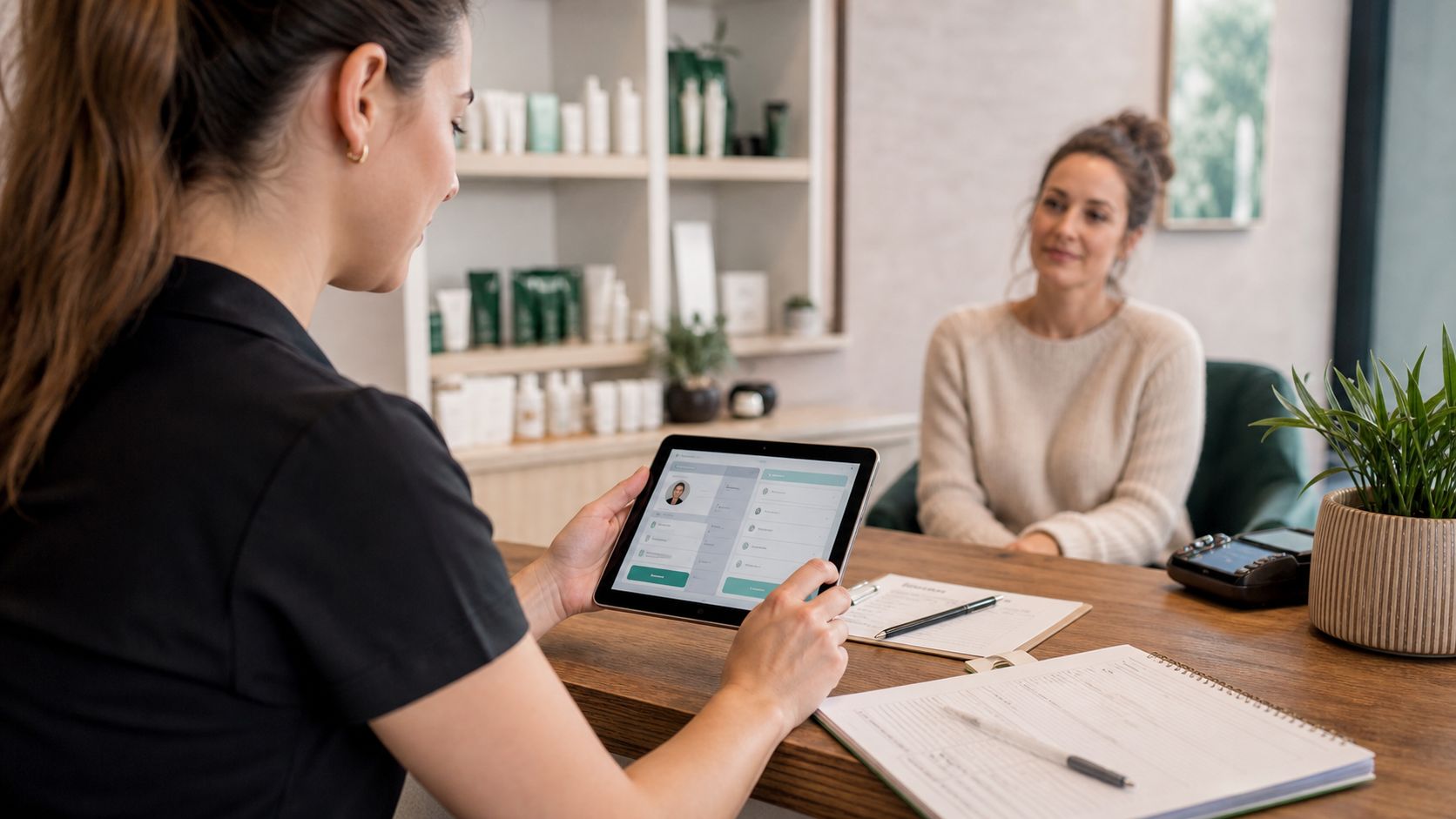
Client retention for a service business means helping the right clients return at the right moment, with enough context that the next visit feels familiar instead of starting from zero.
That sounds like marketing, but in a salon, clinic, studio or wellness center it is also operations. A client comes for a first visit. Someone takes notes. A specialist recommends a next step. The client leaves happy. Then three weeks pass, then six, then ten. If the business waits until the relationship feels cold, the next message already has to work harder.
Retention is easier when it is built into the way the team records, books, follows up and reviews client activity. It should not depend on one employee remembering who should come back.
Why client retention deserves its own workflow
Most service businesses already try to bring clients back. They send reminders, seasonal offers, birthday messages, Instagram posts or discount campaigns. Those can help, but they do not solve the main problem on their own.
The main problem is timing and relevance.
Clients notice when a business remembers the basics and they notice when it does not. Generic communication can still work for broad announcements, but it is weak when the client has a clear service history, preferred rhythm, or unfinished plan.
For a local appointment business, that does not mean every message needs complex automation. It means clients notice whether the business remembers the basics: what they booked, when they usually return, what was discussed last time and whether the next suggestion makes sense.
Good retention starts before the campaign. It starts with the client record.
Start with the repeat-visit rhythm
Different services create different return patterns. A manicure, physiotherapy plan, massage routine, hair removal treatment, dance class membership and aesthetic follow-up do not share the same rhythm.
Before deciding what to send, answer a simpler question: when should this client naturally come back?
Useful rhythm signals include:
- the service booked last time;
- the usual interval between visits;
- the specialist’s recommendation;
- an unfinished treatment plan or package;
- product or aftercare context;
- the client’s last cancellation or no-show pattern;
- seasonality around the service.
This keeps retention practical. You are not trying to “engage the database”. You are trying to help real clients continue something they already started.
What belongs in a useful client record?
A client record should be more than a phone number and email address. It should help reception, specialists and managers understand what should happen next.
For repeat visits, the most useful context is often simple:
- recent and upcoming bookings;
- services used;
- notes that matter for the next visit;
- forms and preferences;
- active memberships, vouchers or remaining visits;
- purchases and balances;
- communication history;
- source, group or client segment;
- online booking status and duplicate profile quality.
When this context lives in one client record, the team can act with more confidence. A receptionist can book the next visit without guessing. A specialist can continue the conversation from last time. A manager can see whether the client base is clean enough to trust.
The goal is not to store everything. The goal is to keep the few details that make the next visit smoother.
Segment by behavior, not by mood
Retention gets messy when every idea becomes a campaign to everyone.
A better approach is to group clients by behavior. A simple RFM lens can help: recency, frequency and monetary value. In plain language, that means how recently the client visited, how often they come back and what value is connected to their visits.
In an appointment business, use that language directly:
- Recency: when did the client last visit?
- Frequency: how often do they usually come back?
- Value: what services, packages, memberships or products are connected to them?
This is enough to create useful groups:
- loyal clients with a normal return rhythm;
- clients who are late for their next likely visit;
- new clients who have not booked a second appointment;
- package or membership clients with unused value;
- clients whose visits need more careful context;
- clients who only respond to seasonal services;
- inactive clients who may need a softer reactivation message.
With marketing and retention tools, the business can choose audiences from real client data instead of sending the same offer to everyone.
Follow up before the relationship goes cold
The most natural retention message often happens shortly after the visit.
For some businesses, that message is practical: care instructions, a form, a product note, a link to book the next session or a reminder about a treatment plan. For others, it is lighter: “Here is how to keep the result longer” or “When you are ready for the next visit, these are the best options.”
The mistake is to wait until the only remaining tool is a discount.
Useful follow-up moments include:
- after the first visit, while the client still remembers the experience;
- before the expected return window;
- when a membership, voucher or package still has unused value;
- after a missed or cancelled appointment, if the tone stays helpful;
- before seasonal demand starts;
- after a review or feedback signal.
This does not need to feel pushy. In many service businesses, a timely message is useful because the client wanted to continue but did not stop to organize the next appointment.
Make rebooking easy at the right moment
Retention breaks when the message is good but the booking path is awkward.
If the client receives a follow-up and then has to call, wait, explain the service again and ask which slots are available, the business has created friction at the exact moment it should remove it.
The rebooking path should be clear:
- the service is easy to identify;
- available times are real;
- rules are visible before confirmation;
- reminders and updates are handled consistently;
- the new appointment returns to the same schedule the team uses.
Online booking matters here because retention is not only about the message. It is about the next action. Notifications and reminders then keep that action from depending on memory.
Keep the team context human
There is a thin line between helpful retention and awkward automation.
Clients do not want to feel like a row in a spreadsheet. They also do not want to repeat the same details every time they come in. The team needs enough context to sound prepared, not scripted.
Small human details matter:
- “Last time you mentioned the skin felt dry after the first day.”
- “You still have two visits left in the package.”
- “The next appointment should be a little longer because this is a correction.”
- “You usually prefer mornings, so I checked those first.”
That is why retention should connect with operations, not sit in a separate marketing file. A better membership and voucher setup, cleaner records, useful notes and a shared communication history all help the team continue the relationship naturally.
Measure retention with practical signals
Retention should not be judged only by how many messages were sent.
Useful questions are closer to the business:
- How many first-time clients book a second visit?
- How many clients return inside the expected service rhythm?
- Which services create the strongest repeat pattern?
- Which clients have unused packages, vouchers or memberships?
- Which campaigns create bookings, not only clicks?
- Which staff, services or locations have a stronger repeat rate?
- Which clients are drifting away before the team notices?
Reports and analytics help turn retention from a feeling into a working habit. The goal is not to chase every metric. The goal is to spot the moments where a small action can bring a client back before the relationship is lost.
A practical client retention checklist
Use this checklist before building another campaign:
- Define the natural return rhythm for your main services.
- Keep visit history and useful notes in the client record.
- Clean duplicate client profiles before using lists for campaigns.
- Identify clients who should have booked again but have not.
- Create follow-up moments around first visits, plans, packages and seasonal needs.
- Make the booking link or online path clear in every retention message.
- Keep reminders separate from promotional messages.
- Train the team on what to check before speaking with a returning client.
- Review second-booking rate, repeat visits and unused value every month.
- Stop sending broad offers when a smaller, more relevant message would do the job.
If the team cannot explain who should come back and why, the retention process is still guessing.
Where Reservation.Studio Business fits
Reservation.Studio Business connects the parts that make retention work in daily life: client records, appointments, online booking, reminders, memberships, vouchers, marketing audiences and reports.
That matters because bringing clients back is not one message. It is a chain. The team needs to know who the client is, what happened last time, when the next visit makes sense and how to make that next booking easy.
When the record, schedule and communication work together, client retention stops being a monthly campaign panic. It becomes a calmer habit built into the way the business already serves people.