
Structure services with categories, durations, price options, package services, and online booking rules.
The foundation behind the calendar
Bookable times that reflect real capacity
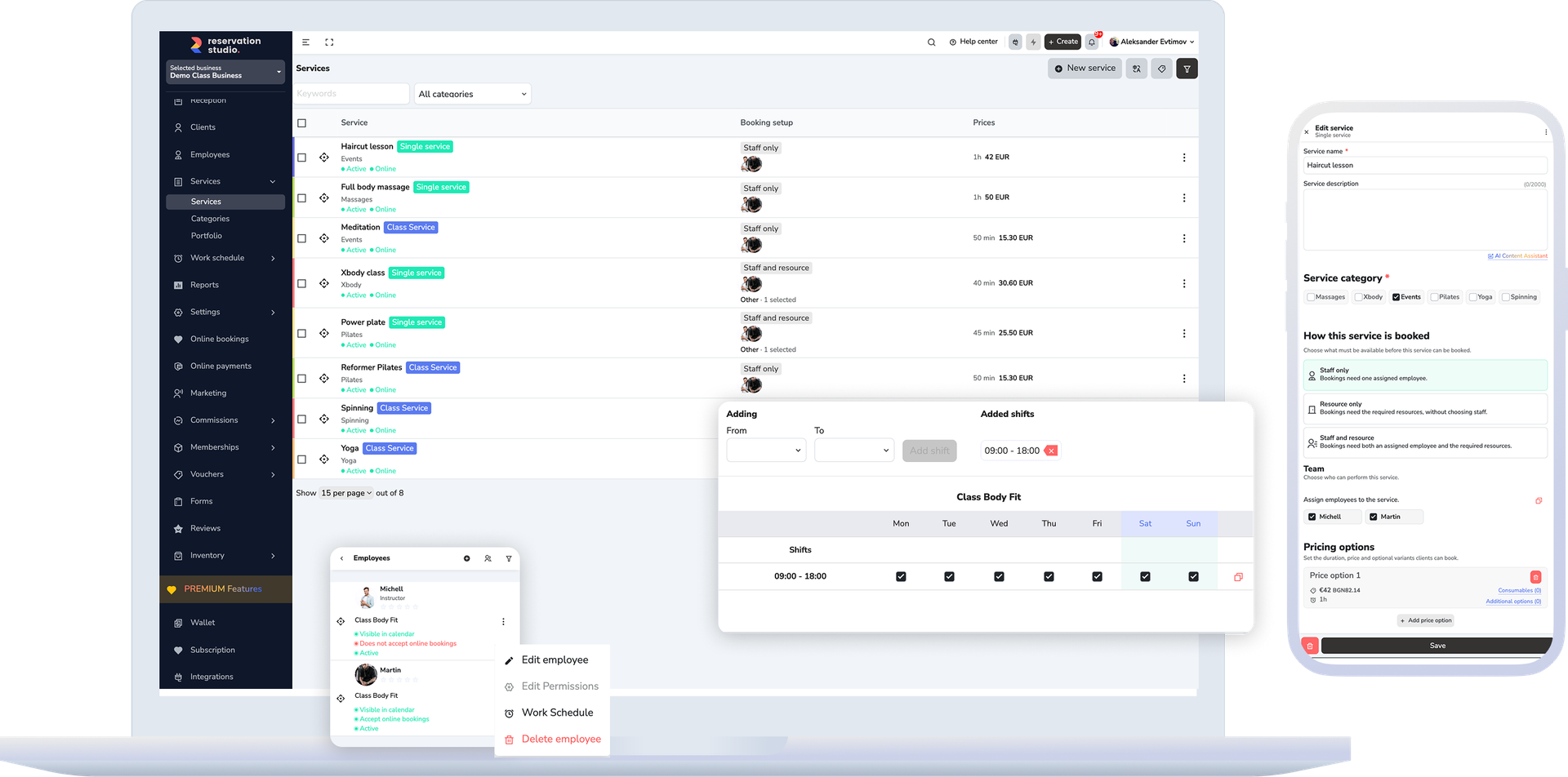
A bookable time does not depend on the calendar alone. It depends on which service is offered, who can deliver it, where it happens, how long it takes, which working hours apply, and whether a room, device, bed, chair, or other resource is available.
Why this matters
Clients only see the right time when the internal setup is aligned
In salons, clinics, studios, and teams with more than one person, availability can drift away from reality quickly. One staff member is not connected to the right service, one location has no working hours, or one resource is already busy.
Connect staff, locations, and services so the system knows who can be booked, where, and for what.
Use working hours, blocked periods, and resources with capacity to reduce wrong bookable times and double bookings.
How this should work
The chain that turns a slot into a bookable time
Availability is built in the same order almost every time. If one link is missing, the slot simply does not appear — not in the calendar and not online. That makes this chain the checklist whenever something is missing.
- There is an active location, and an active employee connected to that location.
- The service is connected to the correct location and the correct employee.
- If the service uses a resource — a room, device, bed or workspace — that resource is active and connected.
- The correct "Employee availability source" is selected on the location.
- Working hours exist for that source, and there is no blocked time for that moment.
- Online booking runs on the same chain, plus advance booking rules and time intervals.
What this includes
Who can take bookings, where, and when
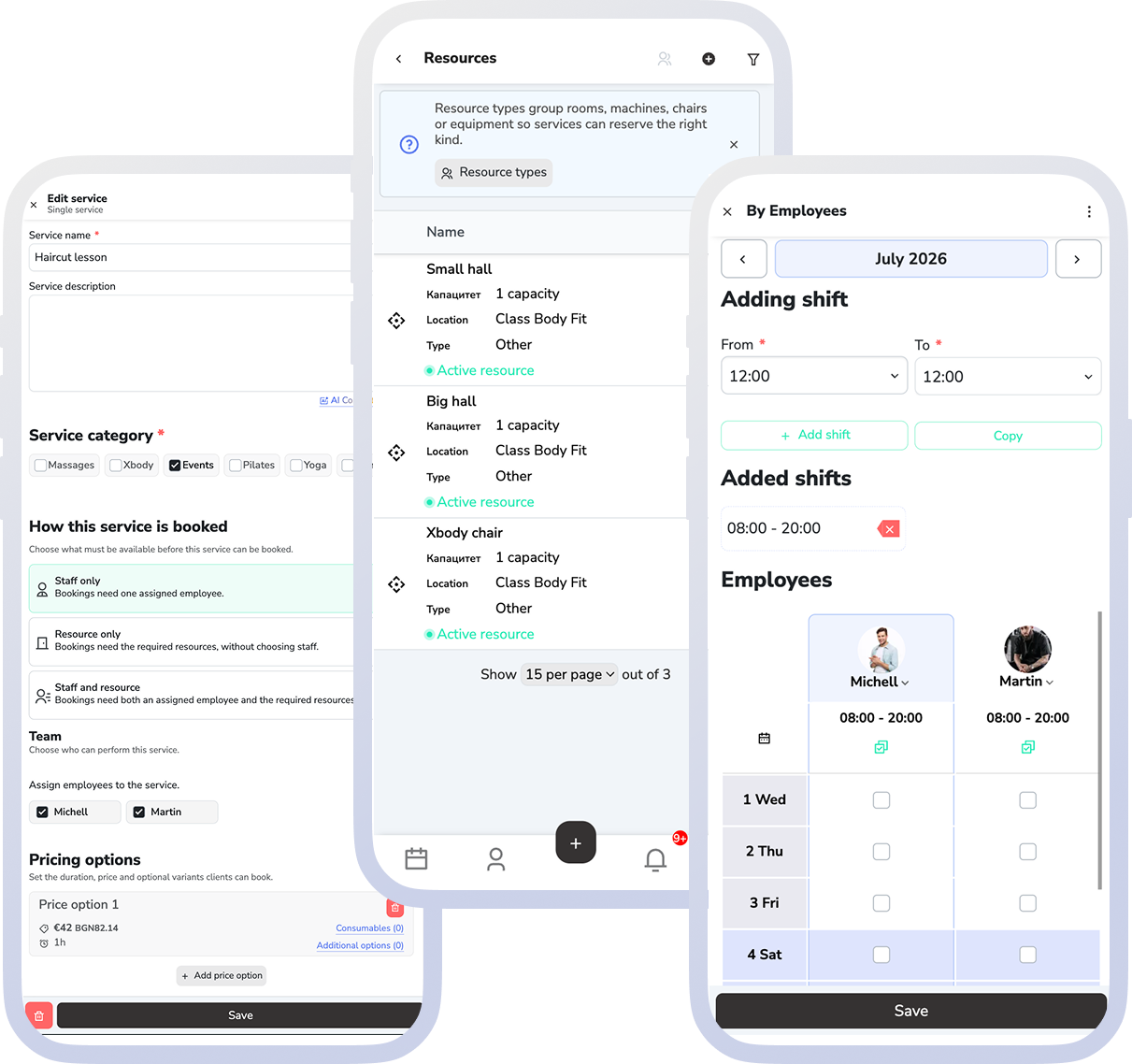
Four screens define the whole chain above, and the setup order is the same: locations first, then people, then resources, then time.
Locations
Where you work — the location carries the services, the team, and the online profile. This is also where "Employee availability source" is selected.
Employees
Who works, in which locations, with which services and with what permissions. "Roles and permissions" decides who sees and changes what.
Resources
The rooms, devices and spaces that actually cap capacity. You use them only when the service depends on them.
Working hours
Location and employee hours, plus "Blocked time" for breaks, absences and repairs — a temporary exception that leaves the permanent schedule intact.
Services and prices
Duration, categories, price options, package services and service types — the catalog everything else builds on.
What the business gains
More accurate bookable times and fewer manual fixes
When setup is clear, the team spends less time explaining why a time is missing, why it appeared under the wrong staff member, or why a client managed to book something the business cannot actually deliver.
More reliable online booking
Clients see times that match the real location, service, staff member, resource, working hours, and booking rules.
A cleaner calendar for front desk and staff
Less time goes into moving bookings, clarifying details, and tracing which setup rule caused the wrong availability.
Easier growth across people, services, and locations
A new staff member, service, or location can be added more cleanly without disrupting availability that already works.
Better control over real capacity
Shared rooms, devices, beds, chairs, and other resources affect booking only where they truly limit simultaneous appointments.
Availability FAQ
What teams ask most often about bookable times
What determines which times appear online?
An online time depends on the service, location, staff member, working hours, blocked time, resources, and online booking rules. If one part is missing or conflicts with another, the time may disappear or appear incorrectly.
When should we use location hours and when should we use staff schedules?
Location hours work well when the whole business follows one shared frame. Staff schedules are better when people work different shifts, take different breaks, or move between locations and months.
When do we actually need resources?
Use resources when a specific room, device, bed, chair, or workspace limits how many appointments can run at once. If the only limit is the person and the time, a resource is not required.
How is blocked time different from working hours?
Working hours define when bookings can generally happen. Blocked time temporarily closes part of that availability for a location, staff member, or resource without changing the permanent schedule.
Can one service have different pricing or duration?
Yes. Services can use price options and additional setup, including variants, prices by location or staff member, group options, package services, and extra time before or after the service.
Next step
See online booking, front desk, or book a demo
If the issue is what clients see online, open online booking. If availability already affects the live day, see front desk. If you want to structure the full model for services, team, locations, and resources, book a demo.