
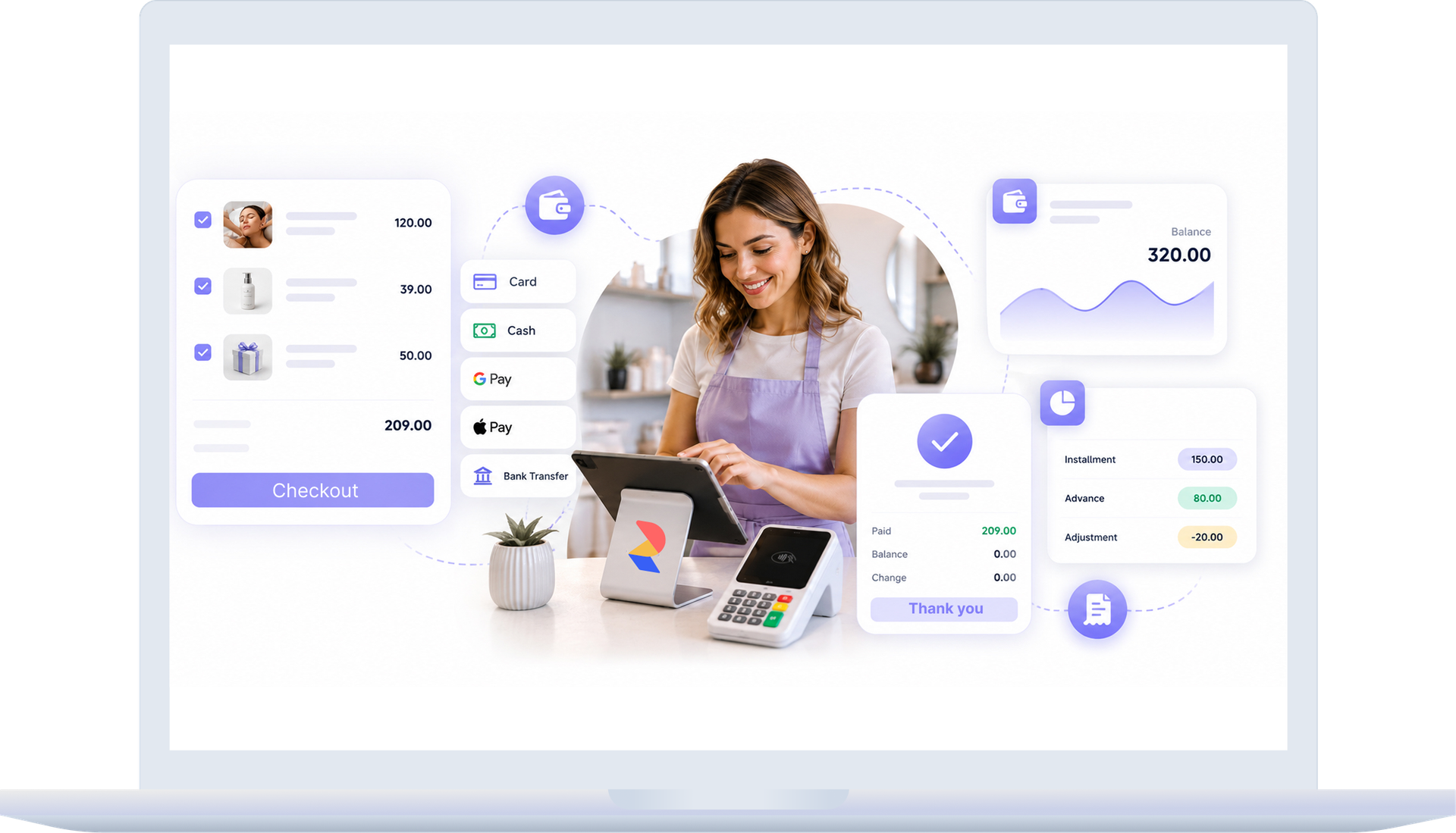
Close services, products, memberships, vouchers, and wallet loading in one shared sale record.
Payments, sales, and balances
Payments and balances around the real visit
One sale gathers the services, products, memberships and vouchers, while "Payment methods", "Installments", "Cash registers" and "Fiscal devices" decide how it closes.
Why this matters
Payments should finish the visit, not create more work
The issue is rarely only accepting cash or card. The issue starts when services, products, deposits, balances, vouchers, and corrections split into separate paths and the team has to reconcile them at the end.
Take payment now, leave a balance, add a follow-up payment, send a payment link, or prepare an installment plan.
Keep refunds, cancellations, expenses, and cash work in one place under Finance instead of piecing them together later.
Connect the fiscal device to Desktop and the receipt prints automatically after payment, with its data recorded against the same sale.
How it works
From the service to the payment, without leaving the sale
The setup happens once, and after that a sale opens from the client, the appointment or the check-in and closes on the spot — with everything around the payment attached to the same record.
- Set payment methods, discounts, registers, expenses, online payments, and fiscal rules before the team starts working live.
- Open a sale from the client, the appointment, or the check-in and collect services, products, or vouchers in one record.
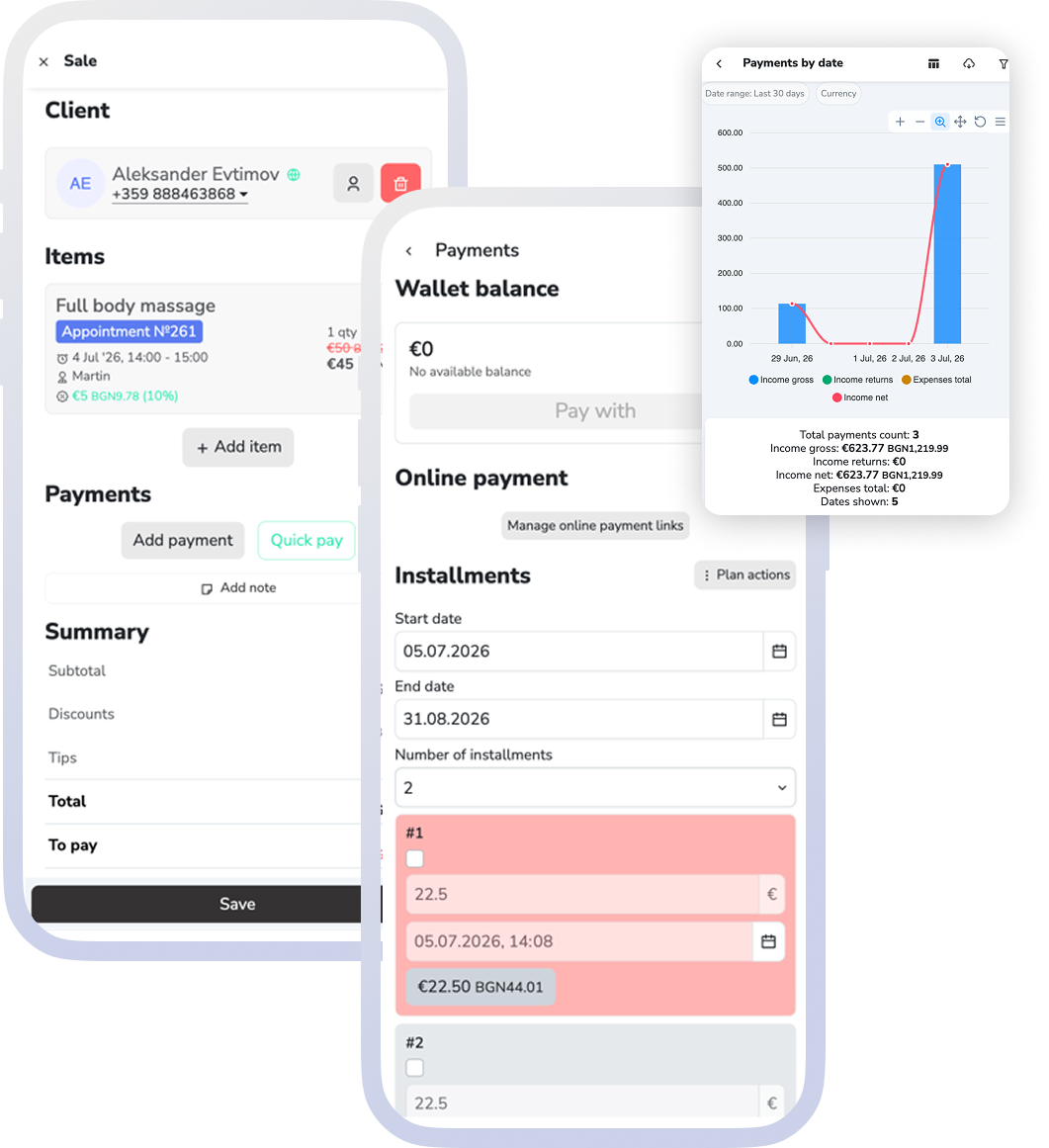
- Record a full or partial payment, use client balance, leave an amount due, send a payment link, or create an installment plan depending on the situation.
- If you work with a fiscal device, the receipt prints right after payment — Desktop finds the device on its own, with no second software and no manual re-entry of amounts.
- If a later payment needs a top-up, refund, or cancellation, the correction stays linked to the original payment instead of losing the history.
What this includes
The screens behind closing the day
Setup and daily actions are separate topics under Finance — under the names the team will see.
Sale
Client, items, payments, installments and tips in one record. It opens from the client, the appointment or the check-in instead of closing the visit in pieces.
Payment methods and Discounts
Active payment methods and the fiscal payment type, plus the discount rules that change the price before the payment itself.
Installments and Online payments
An installment plan when the sale does not close at once, and Stripe for client online payments and prepayments.
Cash registers and Fiscal devices
Register balances, deposits and withdrawals; fiscal printing needs a selected device and operator details, while Desktop finds the device itself and records the receipt number against the payment.
Voids, refunds, and expenses
Corrections stay tied to the original payment, and expenses are organized by "Expense types" so they can be filtered later.
What improves
Faster checkout and a clearer money picture during the day
The team closes visits with fewer manual clarifications, while managers can see earlier what was sold, what was paid, what remains due, and what was corrected.
Faster visit closeout
The sale can start from the client, the appointment, or check-in and still end in one clean checkout and payment record.
Clearer balances and next payments
The team can see more easily what was paid now, what remains due, and where installments, vouchers, client balance, or added payments are involved.
Better control over money during the day
Cash work, the printed fiscal receipt, adjustments, expenses, and the reporting trail stay visible in time instead of being fixed at the end of the day.
FAQ
What teams usually ask about payments
Does the system connect to a fiscal device?
Yes. The fiscal device connects by cable to the workstation running Desktop, and the receipt prints automatically after payment. The receipt number, its timestamp, and the fiscal memory serial are recorded against the payment, so the sale and the fiscal document are not kept in two places.
Which fiscal device models are supported?
Datecs FP series (DP-150, DP-05, DP-25, DP-35, WP-50), Datecs X and MX series (DP-150MX, DP-150X, DP-25X, WP-50X, FP-700X, FMP-350X, and the other models in those series), and Daisy (Compact M). Desktop recognizes the connected device on its own, without picking a model manually. If your model is not on the list, mention it during the demo and we check the connection.
What else can the device do besides a fiscal receipt?
A non-fiscal service receipt, a reversal receipt, a duplicate of the last receipt, X and Z reports, a cash-in-drawer check, cash in and cash out, syncing the device clock to the computer, and device diagnostics. Which of these are available depends on the device itself.
What happens if the receipt fails to print?
The payment is recorded with a failed fiscal status instead of leaving no trace. The team can see which payments still have no receipt and print them once the device is ready.
Is this the same as platform billing?
No. This page is about money operations inside the business: sales, payment methods, vouchers, installments, adjustments, expenses, and cash handling.
Does Sale handle only services, or products and memberships too?
It handles the wider checkout flow. Services, products, memberships, vouchers, wallet balance, tips, and payment links can all be part of the same sale.
Can checkout start from an appointment or check-in?
Yes. A sale can start from the client profile, the appointment, check-in, memberships, or another place in the system and still end in the same sale and payment record.
Can part of the amount stay for later?
Yes. The sale can be saved as partially paid, leave an amount due, receive an added payment later, or use an installment plan.
Can we correct a recorded payment without rewriting history?
Yes. Recorded payments are corrected through payment adjustments, cancellations, or refunds that stay linked to the original payment.
How did the euro transition go?
The system was ready before the switch itself: dual prices in lev and euro showed automatically from June 2025, and the currency change recalculated prices, sales, and inventory automatically. The change calculator works with the amount received in lev or euro, which helped front desks through the months with both currencies in circulation.
Are expenses handled here too?
Yes. Expense categories and everyday expense entry belong to the same finance area, not something kept separately.
Next step
See commissions, memberships, or book a demo
If the next question is how revenue turns into earned and paid-out commissions, open commissions. If memberships, vouchers, and usable value after the sale are the bigger issue, open that page next. If you want to see checkout and payments working in one system, book a demo.